
The Cactus Bee
The President's bollards are no match for the Big Bend region

"but oh my desert
yours is the only death I cannot bear"
-- Richard Shelton, "Requiem for Sonora"
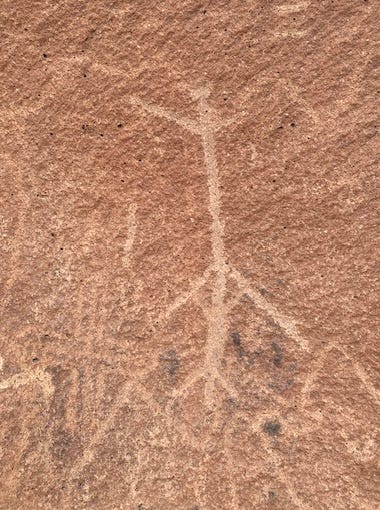
I’m sitting on a piece of ancient volcanic rock whose upper surface has been worked smooth and flat by the graciousness of time when I see a tiny dot of gold crawling up and down and through the grey-brown sand of a desert floor made by the play of siblings: the mountains behind me and the river before me.
It is a male cactus bee, newly born into this March morning, prowling the sand and gravel for a female still underground. Relative to the slow pace of the mountains’ walking - beneath the mountains the dropped limestone is still being uplifted by three inches per century - the cactus bee is lightning quick. Relative to sedentary me, its journey of a few feet covers the length of a feature movie.
The cactus bee moves with a certain innocence, not burdened but lifted by its past. I’m here hunting, too, in my case for ways to protect the desert life of the Big Bend region from human vanity and folly. And what can be more vain than that? The bee is more confidant than I am.
Just behind me on the wall of fallen rock are petroglyphs drawn by unknown indigenous people 3,000 to 5,000 years ago. There are elongated human stick figures who, dreaming, shake their heads at the planned degredation of their world. I can feel them. The President of the United States wants to vandalize the tender landscape of the Chihuahuan Desert along the northern banks of the Rio Grande. It is profane.
The cactus bee pauses briefly and seems to vibrate. Then it’s onward over what is no more than an enlarged grain of sand.
The president sees steel walls thirty feet high along the northern bank of the river. He thinks it a symbol of his splendor, a gesture to his followers of his supremacy. It can be no more than that, because it is intended to keep out immigrants from the south who are not there, who do not brave a barrier far more magnificent than he: hundreds of miles of desert mountains of Northern Mexico.
Of a sudden, the rolling swagger of the cactus bee reminds me that the desert will, in the end, defeat the presidential nightmare. The desert needs no requiem, but I’ll leave Richard Shelton’s “Requiem for Sonora” as epigraph because our fears are real. Still, the desert will be live and dreaming long after the president’s bollards have been rusted to nothing by wind and river.
We can take some comfort in that, but it will not stop the pain and suffering in the shorter term if the president executes his plan. Ways of life along the river will be disrupted or snuffed out. Wealthy landowners and the desert’s scrappy working families will share similar fates. Beloved state and national parks will be devastated. The globe’s largest binational game preserve, the grand achievement of decades of work by the state of Texas and the United States and Mexican governments, will be destroyed.
Billions of dollars of taxpayer money would be spent on this unnecessary destruction. There are far less intrusive and less expensive measures already in place along the border in the Big Bend region. There are easily movable “autonomous surveillance towers” that keep an eye out for those who might arrive at our national threshold without invitations.
The cactus bee continues on its way, and I think of the unprecented political unity I’ve found out here in West Texas. Conservative and liberals who would argue life and death over what to have for breakfast stand in solidarity against the president’s plans. I have seen the hope and frustration in their eyes. The hope’s there because like so many Davy Crocketts they know they’re right and go ahead. The frustration is there because they also know that many Americans don’t understand the simple truths these desert dwellers feel in their bones.
Is there a solution to be had in the U.S. Congress? The cactus bee is still on the hunt. I’m reminded that the word congress means "coming together,” and centuries before the American framers chose to use the word in the place of “parliament,” it was not uncommon to speak of sexual congress. My hopes are with you, dear cactus bee, but not so much, U.S. Congress. Its current leadership has chosen fealty to the president over fidelity to the American people. This is sad because there appear to be many members from the leadership’s party who do understand the damage that could be done to the Big Bend region.
Still, the resolve of those opposed to the presidential plans is enough to give one hope. Every advance toward the American dream has hitched a ride on this kind of resolve. West Texans know they’re running against the odds. But I wouldn’t bet against them. Like the cactus bee, desert folk are rather solitary, but they are also more sociable than many when the time calls for it. There’s power in that.
Perhaps someone will tell the president that there can be no symbolic victory when many of those for whom the symbol is intended read it differently than the president believes they will. Many of these West Texans voted for the president, but they live their lives with an integrity the president does not understand. Yes, maybe someone will tell him and he will choose against poking the bear with an empty gesture that will accomplish nothing in the way of his goals. Everybody out here strongly supports border security. But at the moment they also know they need to secure it against a devastating and unnecessary plan.
It’s time to go. I struggle up from my rock. I’ve lost track of the cactus bee. He’s none the worse for that.
yes yes yes. Thank you Glenn for this heart-felt. heart rending account. You know I feel the same way. We don't yet know if it is a requiem so we must take it as a battle cry. I fantasize about writing a story called The Grinch Who Stole Big Bend and having a happy ending where we invite Trump and Miller to a river trip with us where they experience joy and wonder and awaken their cold and nearly dead hearts.
Beautiful.